
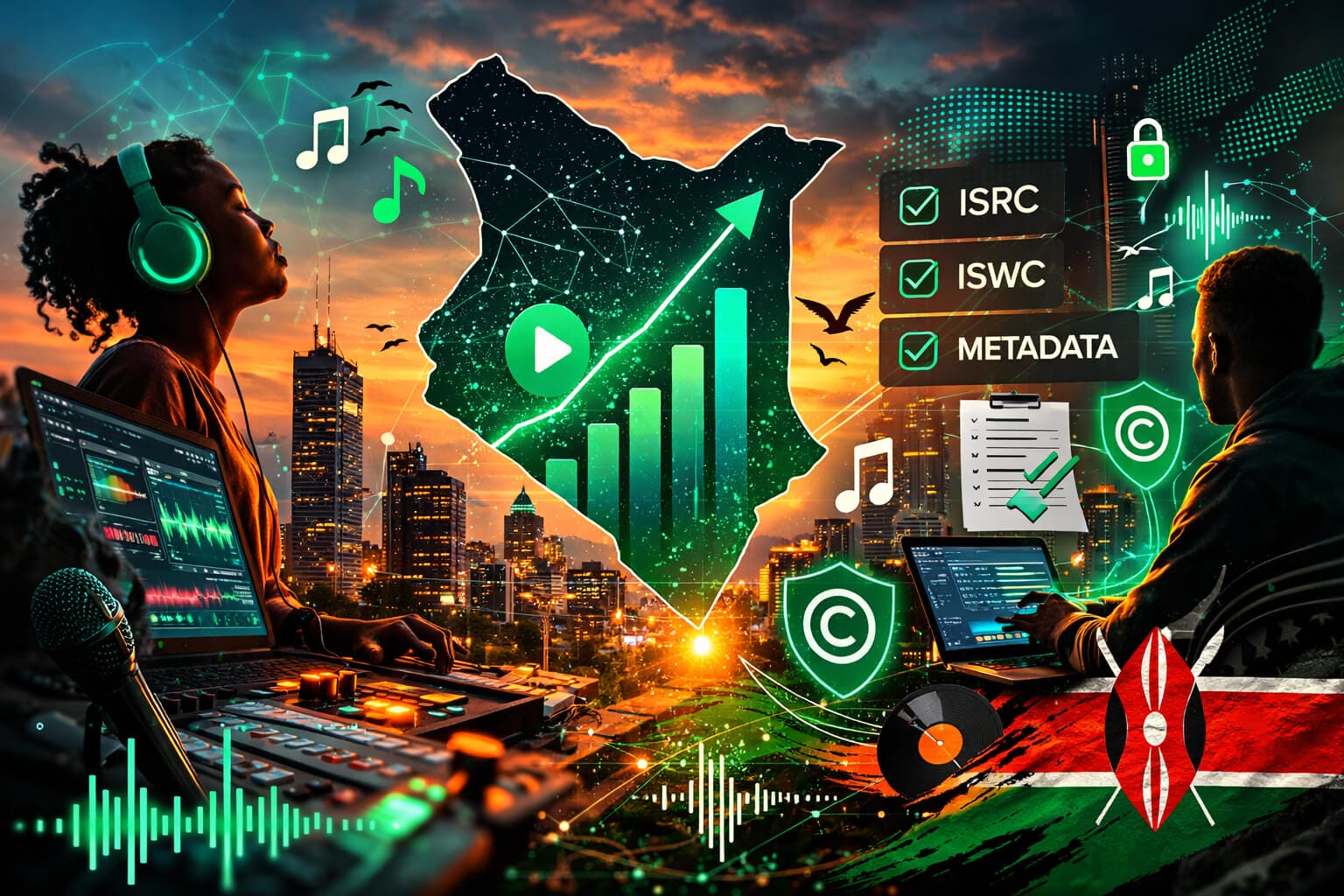
What Spotify says is happening in Kenya
Music In Africa reports that Spotify’s Kenya data (covering the platform’s Feb 2021 launch through early 2026) shows sustained growth and deeper local engagement.
These are Spotify-reported platform signals (not a complete view of the whole Kenyan music economy), but they’re useful for understanding listener behaviour on a major DSP.
Highlights (Kenya, Feb 2021–Feb 2026, as reported):
- +112% growth in the number of Kenyan artists distributing music on Spotify.
- 9+ million user-generated playlists created by Kenyan listeners over five years.
- 203+ million hours of listening time in Kenya in 2025 alone.
- 35+ million hours of podcast listening since launch.
- More local-language upside: listening of Kenyan indigenous-language music rose 101% locally over five years; globally it rose too, including +128% in 2024 and +69% year-on-year growth.
- Genre spikes (2021–2025): amapiano streams up 1,404%, gospel/praise 1,103%, R&B 737%, Afrobeats 680%, hip hop/rap 520%.
- Discovery behaviour: in the most recent month measured, the average listener in Kenya streamed music from 124 different artists; average listener age is 26.
Market trend: Kenya’s streaming growth is getting more local — and more export-ready
The trend isn’t only “more streaming”. It’s more discovery and more local-language listening, which usually means:
- back-catalogue keeps earning longer,
- niche scenes can break through faster,
- and songs travel outside Kenya sooner (playlists, shares, short-form, diaspora listening).
That last point is where the business gets real: once a track crosses borders, your data has to cross borders too.
Also worth saying plainly: more streams don’t automatically mean more income for every creator. What you earn depends on your rights splits, territory rules, and whether your publishing data is accurately matched and conflict-free.
The rights-hygiene link: streaming money follows metadata matches
There are two different assets in play:
- the recording (the master), and
- the song/work (composition + lyrics).
Digital usage generates royalties and reporting that need to be correctly linked back to the right owners and splits. If the “work side” data is missing, inconsistent, or disputed, some royalties can be delayed, misallocated, or sit as unmatched until the system can confidently identify who gets paid.
The three matches that protect your royalty flow
Match the people (writers ↔ identifiers)
- Use consistent writer names across releases and registrations.
- Where available, add IPI/CAE numbers (the global writer ID used across societies).
Match the song (work ↔ registration/ISWC)
- Register the work (song) with the appropriate CMO/publishing pathway for your situation.
- Once assigned, keep your ISWC (the work’s global ID) linked to the correct title, writers, and splits.
Match the recording to the song (ISRC ↔ work data)
- Your ISRC identifies the recording; your publishing info identifies the underlying work.
- Make sure your track-level credits (titles, writers, splits) are consistent so partners can link recording usage back to the right work.
- Standards bodies like DDEX exist to make this data exchange more accurate and automated across the digital value chain.
A practical rights-hygiene checklist (Kenya-ready)
If you only do one thing: get a signed split sheet and keep one source-of-truth metadata sheet per song (titles, writers, splits, ISRCs). That alone removes most avoidable mismatch risk.
Before release (or before a campaign push):
- Split sheet signed: writers + percentages + real names captured in writing.
- One source-of-truth sheet for every song:
- final title + alternate titles
- writers + roles
- IPI/CAE (if you have it)
- splits
- ISRC(s) for each master version (radio edit, remix, clean, etc.)
- Register the work as early as possible (don’t wait for the song to go viral).
After release (monthly for 3 months, then quarterly):
- Audit what’s live: spellings, featured artists, writer credits, and titles across services.
- Resolve conflicts fast: duplicate works, wrong splits, missing writers, alternate spellings.
- Track performance vs income: if a track is moving and statements aren’t, investigate early (before the trail goes cold).
Why “unmatched” royalties are real (a quick proof point)
Territories have different rules, but the operational lesson is universal: bad data delays money.
Example (United States, mechanical royalties): in February 2021, the Mechanical Licensing Collective (MLC) announced it had received US$424.384 million in “historical unmatched royalties” from DSPs under the Music Modernization Act framework, alongside large volumes of usage data intended to help match payments to the right owners. The MLC continues to publish progress reporting on historical royalty transfers and distributions.
Where Downtown Music Publishing Africa fits
This is the publishing layer: we help creators and rights-holders clean work data, align identifiers, support registrations, manage conflicts, and strengthen reporting so royalties have fewer reasons to get stuck.
One next step
If your music is picking up on Spotify (or you’re planning a push), do a quick rights-hygiene check: put your track list + writer splits + ISRCs into one doc, and you’ll immediately see what needs fixing first.
Sources
Credits: Kenya market reporting via Music In Africa (Spotify metrics are company-stated); metadata/standards context via CISAC/ISWC and DDEX; unmatched royalties example via The Mechanical Licensing Collective and US trade press.
- Music In Africa — “Spotify reports steady growth in Kenya five years after launch” (24 Feb 2026, Kenya)
- CISAC — “CISAC launches new ‘ISWC IPI Context Search’…” (1 Dec 2025, global)
- ISWC.org — “The ISWC” explainer (accessed Mar 2026, global)
- DDEX — Standards overview (accessed Mar 2026, global)
- The MLC — “The MLC Receives Historically Unmatched Royalties from DSPs” (16 Feb 2021, United States)
- The MLC — “Historical Royalties” progress page (accessed Mar 2026, United States)
- Variety — “$424 Million Up for Grabs as Music Streaming Services Fill…” (16 Feb 2021, United States)


