
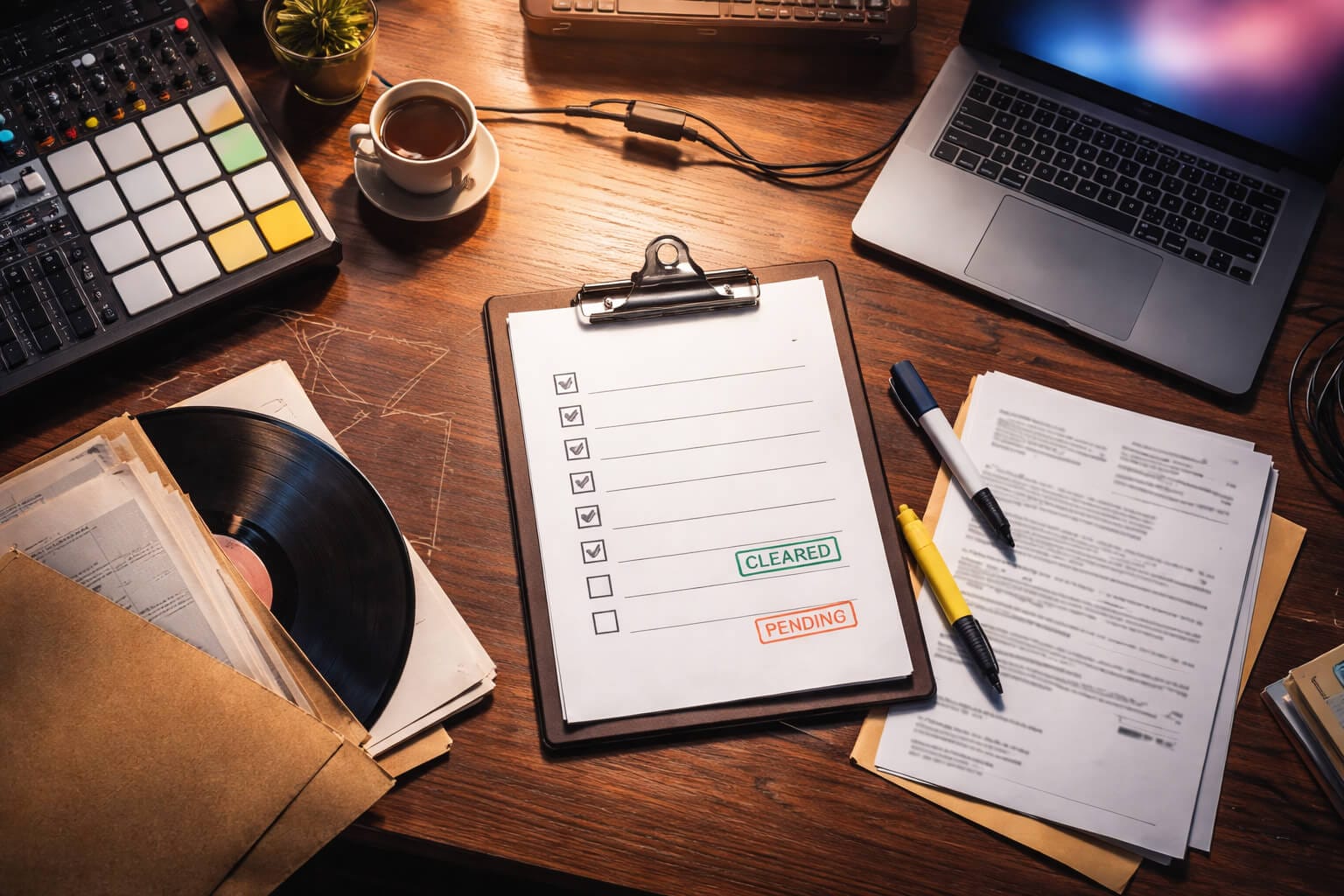
The fast truth: sampling is two copyrights, not one
Credits: built from WIPO’s Intellectual Property & Music hub and Expression Africa’s Feb 2025 reporting on Tracklib’s bespoke sample-clearance model.
Sampling isn’t just “can I use this sound?” It’s can I use this sound recording and can I use the underlying song. Miss either one and you can end up with takedowns, disputes, or blocked releases.
Regulatory context (Africa lens): copyright is territorial, rights ownership is often cross-border, and approvals can sit with multiple parties (writers/publishers + master owners). The safest move is to treat clearance like a release requirement, not an optional extra.
What needs clearing (and when)
1) If you used an existing recording (a true sample)
You usually need permission for:
- The musical work (composition): melody/lyrics/harmony — controlled by writers and/or publishers.
- The sound recording (master): that specific recording — controlled by the label/master owner.
2) If you interpolated (replayed/resung the part)
You typically still need permission for:
- The musical work (composition)
But you generally don’t need the original master permission because you didn’t use that recording.
3) If you used loop packs / “royalty-free” sounds
You need:
- Compliance with the licence terms (platform use, attribution, resale restrictions, limits on “sample libraries”, etc.).
Not legal advice. The point is practical: if you’re unsure, assume it’s work + master until proven otherwise.
Who to approach (so you don’t email in circles)
Composition clearance (work):
- Songwriter(s) and/or publisher/administrator
Master clearance (recording):
- Label or whoever owns the master (sometimes the artist, an indie label, a catalogue buyer, or an estate)
Creator impact: delays usually come from wrong contacts, unclear requests, and missing details. Your email can’t be “we sampled your song” — it must specify exactly what you used and how.
The session log that prevents disputes later
Make the log while you’re still creating — not two days before release. Assign one person (producer/PM/engineer) to keep it updated.
Project details
- Track working title:
- Session date:
- Location (city + country):
- Artist/act:
- Producer(s):
- Writer(s):
- Version: (v1/v2/final)
Sample log (repeat per sample)
- Source type: (recording sample / interpolation / loop pack)
- Source track + artist:
- Where you found it (link):
- Timecode used (start–end):
- Length used (seconds):
- How it’s used: (hook / drums / texture / vocal chop)
- What you changed: (pitch, time-stretch, chop, replay)
- Clearance likely needed: (work / master / both / unsure)
- Who might control rights (names if known):
- When you requested clearance:
- Status: (pending / approved / declined / replaced)
- Terms (if approved): (fee, % master, % publishing, territory, term)
- Proof saved: (signed licence / email approval / invoice)
File hygiene
- Create a folder: “TRACKNAME — CLEARANCE”
- Save: approvals, licence PDFs, invoices, email threads, screenshots of licence terms
- Keep: a dated bounce showing the sample use (internal reference)
The clearance email checklist (what to include)
When you approach rights owners, include:
- Your artist name + legal entity (if any)
- Track title (working is fine) + release plan timing (if known)
- The exact source you used (title/artist) + link
- Timecodes and how the sample is used
- Whether it’s the hook / chorus / background texture
- Where you plan to exploit the track (DSPs, sync pitching, socials)
- Your request: a licence and proposed terms (or ask for their terms)
A workflow that actually works (no fantasy timelines)
- Tag each sample early: clearable / unclear / replace
- Start clearance before final mix: don’t wait for “perfect” to begin paperwork
- Lock your own splits first: your internal credits need to be clean before you add rights owners
- Get it in writing: verbal approval isn’t clearance
- Only schedule the release once you’re clear: your release partners may require warranties that all samples are cleared
Tracklib’s bespoke model (what to learn from it)
Expression Africa reported in February 2025 that Tracklib launched a Bespoke Clearance Model, positioned as higher upfront cost in exchange for a lower revenue share.
Whether you use Tracklib or not, the principle is useful: know the terms upfront, and keep documentation tight enough that a third party can audit it.
What to avoid (takedown magnets)
- “It’s small, nobody will notice.” Permission isn’t based on how short it is.
- Clearing after the song pops. Your leverage drops when the track has momentum.
- Sampling from random uploads where ownership is unclear.
- Taking a “sample-ready” beat without seeing the actual clearance proof.
- Assuming “royalty-free” means “no rules.” Licences can still limit use.
- Not logging in-session. If it’s not written down, it’s not controllable.
If you can’t clear it, pivot clean
- Interpolation (still needs composition clearance)
- Commission original parts that capture the vibe without copying the audio
- Use clearly licensed sounds with terms you can prove
- Replace early (before mixing, mastering, and content rollout)
Where Downtown Music Publishing Africa fits
Publishing is where creativity meets clean documentation. We help creators get credits, splits, and catalogue data release-ready — so your music can travel without avoidable disputes.
One action this week (creator CTA)
Pick your two most active unreleased songs and create a Sample Log + Clearance folder for each. Make it a studio habit: no log, no bounce.


